
Native Gardens Are Becoming the New Normal
Hell, even Donald Trump has tried it. (But it's not clear he paid the bill.)

by Richard Conniff
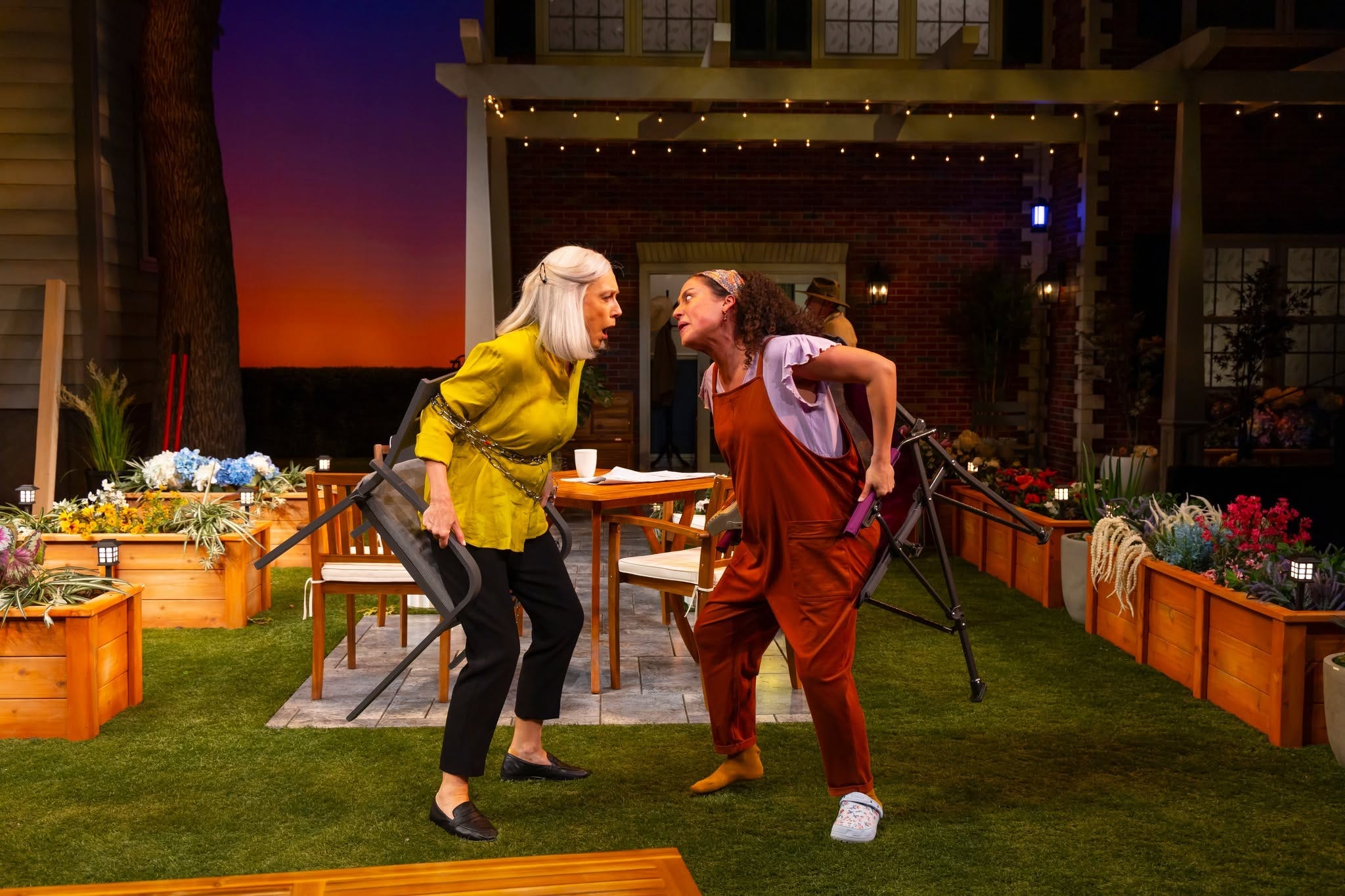
Earlier this year I caught a production of “Native Gardens,” a play by Karen Zacarias, about a young Latinx couple moving into a fixer-upper next to a WASPy older couple in a perfect Federal townhouse. They come to blows, or almost, on gardening styles—pollinator- and native plant-friendly versus ornamental flower traditionalist.
“It’s the pesticides, isn’t it?” says the obsessive-compulsive traditionalist, in a defensive moment. “They get a bad reputation. But I need them. I’m telling you: Organic gardens get eaten alive.”
“I know!” answers the exasperated newcomer. “That’s the point of organic gardens!!!”
I laughed. But the play, now experiencing a wave of revivals, also felt a little dated. In the ten years since it premiered in 2016, native gardening has gone mainstream. The people planting these gardens now come from almost every generational, social, ethnic, or economic category. And their gardens range from a window box on a fifth floor walkup to Martha Stewart-style country estates. Nor is it just individual gardeners. Garden clubs, city park departments, major league sports franchises, homebuilding companies, and corporations are all planting native species and celebrating the bees, butterflies, and birds that turn up.
Homeowners associations, for instance, have long been notorious for going after neighbors with insufficiently manicured lawns. But some are now just as likely to have the talk with neighbors who fall short of native planting goals, and residents apparently like the change. A 2025 study in Wisconsin found that when HOAs put limits on lawn size and required even modest use of native plants, the affected properties averaged 42 percent native plant coverage—compared to just seven percent coverage in yards without those requirements.
Even Donald Trump, otherwise notorious for wreaking havoc on wildlife, has sponsored native plantings at his golf course in Bedminister, NJ. A 2017 report from the New Jersey Audubon Society, which worked on the planting program, boasted that native birds from bobolinks and savannah sparrows “to the brilliant Indigo Bunting and Baltimore Orioles are utilizing the new habitat areas.” (Was it just a Trumpian ruse to ease through some permitting requirement? An Audubon executive now advises, cryptically: “We have nothing to do with Trump National anymore.”)
I don’t mean to suggest that native gardens are transforming private yards and public spaces everywhere. Maybe next year? Nor have gardening squabbles and neighborhood side-eye suddenly vanished. Expect that never. These days, though, even traditional gardeners become apologetic on the question of native plants and the wildlife they benefit.
“It’s not like I’m against birds and bees,” one such gardener told me. “It’s just that …” She gestured. Her garden was clearly a product of years of hard work, and it was undeniably beautiful. It was just out of sync with the dire headlines about the decline of birds, butterflies, and other wildlife, and she knew it.
People now hear about the potential of native plants to reverse that decline from every gardening website, magazine, book, podcast, substack, and television show—and from non-gardening outlets, too. One particular statistic resonates persuasively. It comes from the 2020 book Nature’s Best Hope by Doug Tallamy, a University of Delaware entomologist who has detailed just how completely our familiar birds depend on native plants and insects at breeding time.
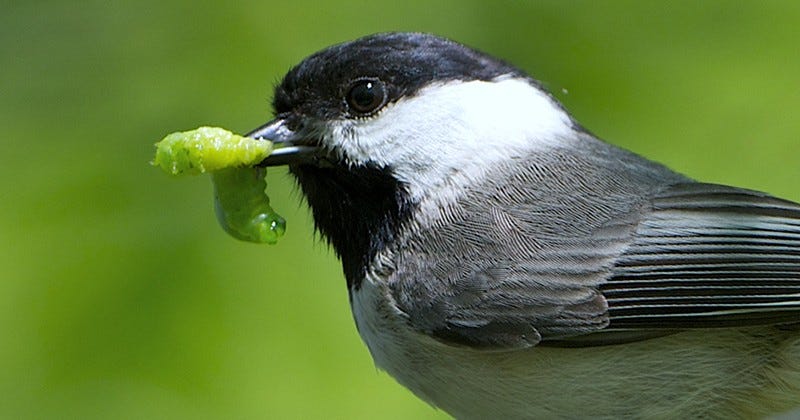
Here’s the statistic: A single pair of Carolina chickadees needs to bring 350 to 570 caterpillars home daily to rear a clutch of a half-dozen nestlings to fledging. That’s 6,000 to 9,000 caterpillars over about 16 days. Keeping up that pace means they must find the caterpillars nearby, within an area of roughly two acres. The numbers vary for other species, but the life-or-death rush to find food in the neighborhood holds for almost all nesting birds.
And here’s the hitch: Butterflies and moths mostly lay their eggs (which of course become caterpillars) on the same native plant species on which their ancestors evolved. The caterpillars may have coloration that camouflages them from predators only against the bark of certain trees, or, like monarch butterflies on milkweed, they may depend on chemicals only one plant provides. Going elsewhere isn’t an option.
So if your neighborhood is all tidy lawn, or beautiful daylilies (native to Asia), or treeless except for that introduced (and invasive) Bradford pear (also from Asia), the butterflies, birds, and a whole raft of other desirable species will go elsewhere, or starve. The result: When a lot of people show up at the garden center these days, it’s no longer just to look for pretty plants. They want to know: “What are some plants I can get to feed my butterflies and birds?”
“I do a lot of public speaking engagements,” says David Mizejewski, an ambassador for the National Wildlife Federation’s certified wildlife habitat program. “One of the things I always start my talks with is, ‘Are you familiar with what native plants are?’ And back 20 years ago, almost nobody raised their hand. Today, everybody does. There’s an awareness now that wasn’t there.”
I met Mizejewski in Englewood Cliffs, New Jersey, at the North American headquarters of LG Electronics. It’s a 2020 development, a long, low-slung LEED Platinum building on 27 acres, set back from the Hudson River Palisades. As a participant in NWF’s certified wildlife habitats program, the company has committed to keeping a substantial portion of its property in native plantings. “They involve employees and families,” said Carey Stanton, also with NWF. “And it just keeps getting more and more native plants.”
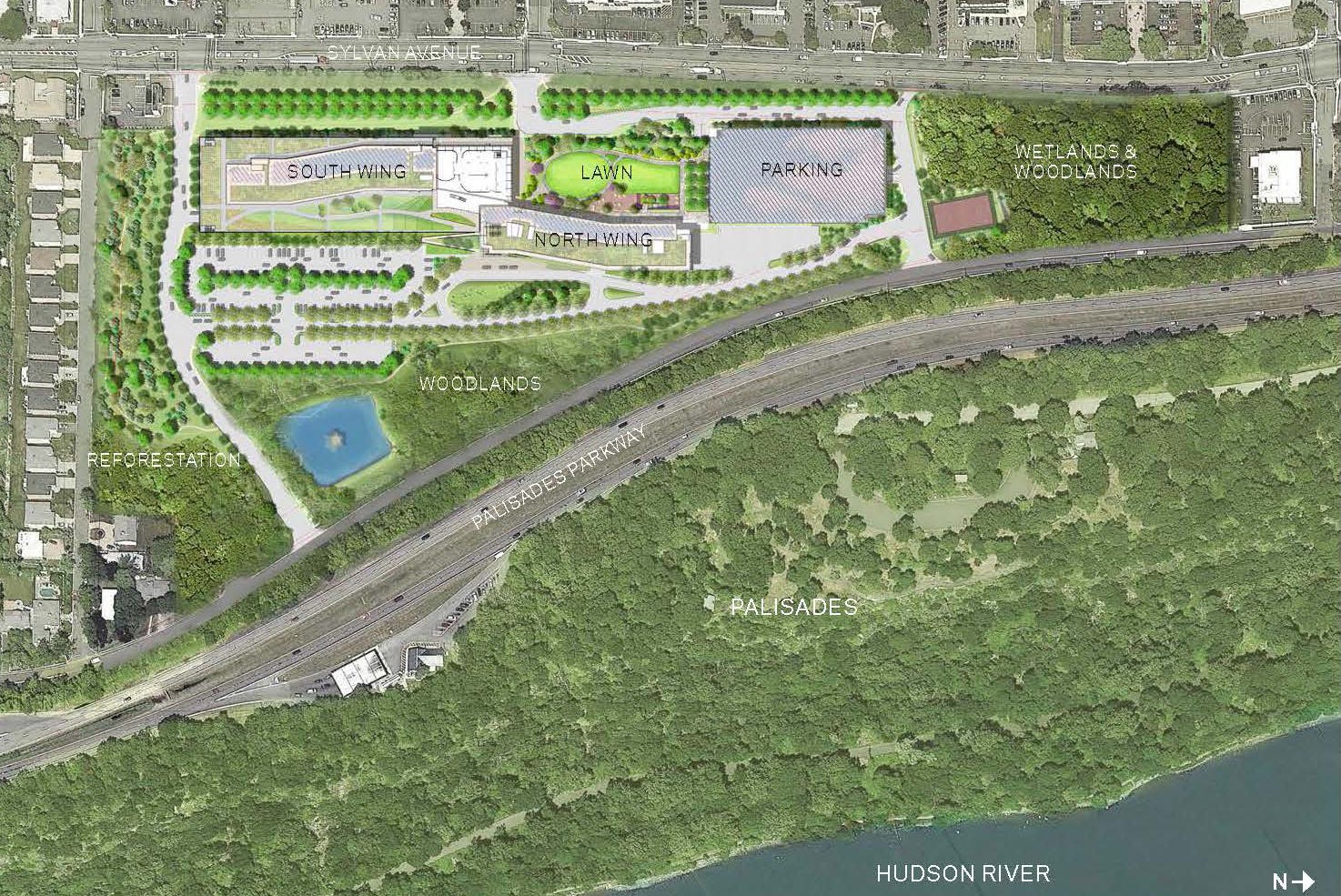
It looks at first like a conventional corporate campus, with a large, neatly trimmed lawn and a regimented line of trees out front, and more trees in rows in the parking lots out back. But the trees are mostly native species, and in the parking lot, the shrubs evenly spaced between the trees are inkberry hollies, “a great native evergreen,” said Mizejewski. “There are ways to work in native species, and that doesn’t need to mean wild-looking. That’s an aesthetic choice. But they’re still going to be providing a benefit even if they’re planted in a neat row.”
At one end of the campus, a paved path wound through a mini-botanical garden of native trees, all labeled, on a lawn neatly punctuated with a perfect circle of bare earth around each tree trunk. Definitely corporate. But on a five-minute stroll, I counted a half-dozen birds, including a Carolina wren. (Also a dead skunk.) A “wetlands and woodlands” area at the opposite end of the campus was wilder, with fallen branches and standing snags.
Company employees had also recently added a pollinator garden to the lawn in front, “And holy cow!” said Mizejewski. “You put in a new garden and it looks almost like nothing. And then, BOOM! So we’ve got bee balm, we’ve got mountain mint—really incredible pollinator plants,” alive with pollinators and with dragonflies and birds hawking insects out of the air for a meal.
“Wait,” said Mizejewski., pausing at a minor disaster area. “This is the other reality. These black-eyed Susans are getting completely chopped, probably by rabbits or deer. And my advice is, ‘You know what? They’re gonna eat stuff.’” Plant more, and plant more densely, he told an LG staffer. “You’re going to notice it less.”
Entirely apart from the benefits for wildlife, studies have repeatedly shown that being in nature—going out for a short stroll in a park, or even just looking out the window at trees, tends to make people (employees included) healthier, happier, and more alert.
It may also boost the bottom line: Taylor Morrison Home Corp., also a participant in NWF’s certified wildlife habitat program, now includes a monarch butterfly garden in each of the 350 or so housing projects it builds annually. It also develops entire communities as habitats for wildlife as well as people, with homeowners associations keeping track of the requirement that yards be 80 percent native plantings, chosen from a pallet of approved native species.
The commitment extends to educating homeowners in the features of the development, says Chad Eby, the company’s sustainability director. At a development outside Phoenix, for instance, residents became alarmed by the presence of the large, roaming wasps known as tarantula hawks. “We did the research and, you know what?, as far as people are concerned they’re not a problem. Now if you’re a tarantula, watch out.”
At another development, in Colorado, the company left the area around a pond native, with tall grasses. Then a tree fell into the pond. “At first the residents were like, ‘What are you guys doing? This looks terrible. We want this cleaned up.’ And then we educated them on how this is creating habitat. Ducks came in. There was an owl that created a nest in that fallen tree. And so the residents, all of a sudden, they understood. Then they started to really follow it and enjoy it.“
Eby says developments with native plants look better, are more resilient, and have lower maintenance and watering costs. Does that also boost the sales price? He ducks the question. But a few days after we spoke, Taylor Morrison—the entire company— sold to Berkshire Hathaway for $6.8 billion, a 24 percent premium over the previous closing price of its stock.
I’d argue that that matters far less than the benefit to wildlife. (But then, I’m not a Taylor Morrison stockholder.) It matters less than creating a place where people can come to know their local wildlife. And anybody with a yard or even a window box can do it, opening their eyes to extraordinary moments in the lives of our fellow Earthlings.
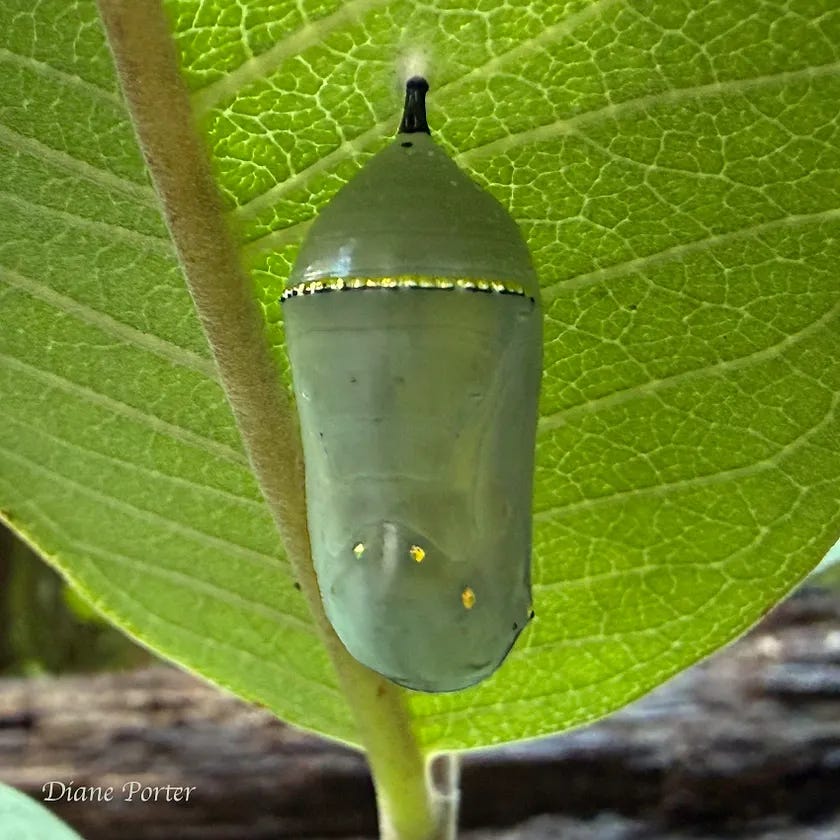
For instance, an Iowa gardener named Diane Porter, Boomer generation, posted the other day on her substack when she noticed a chrysalis hanging by a thread beneath a common milkweed leaf. A chrysalis is a pod in which a caterpillar transforms itself into a butterfly. On milkweed, that butterfly is likely to be an endangered monarch.
She watched for a while and then, “It shone gold lights out of its green case.”
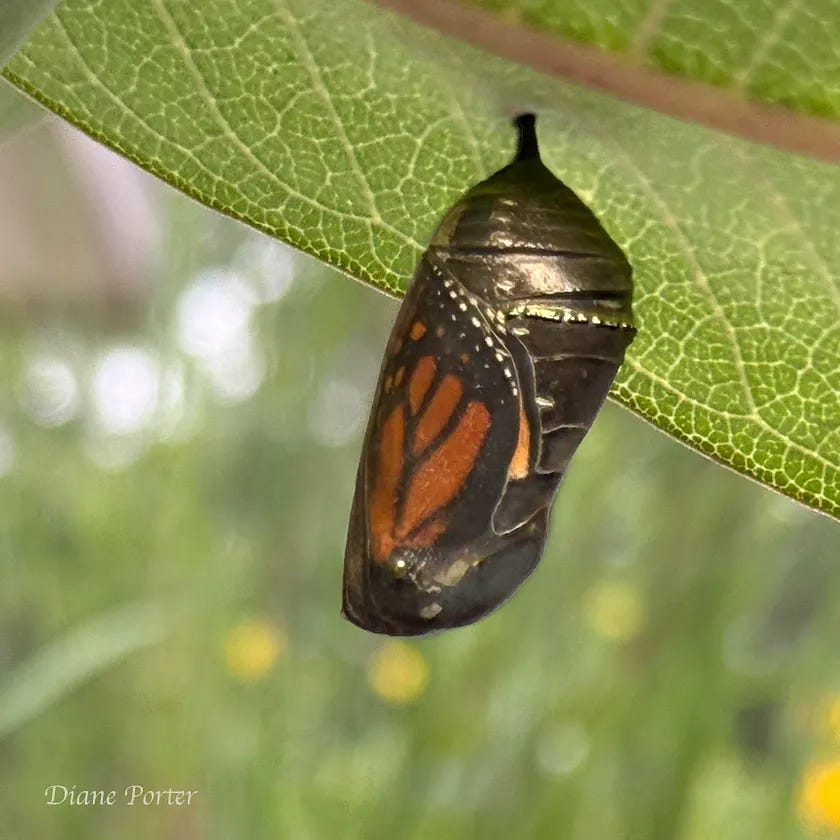
Next day, Porter writes, the chrysalis became transparent:
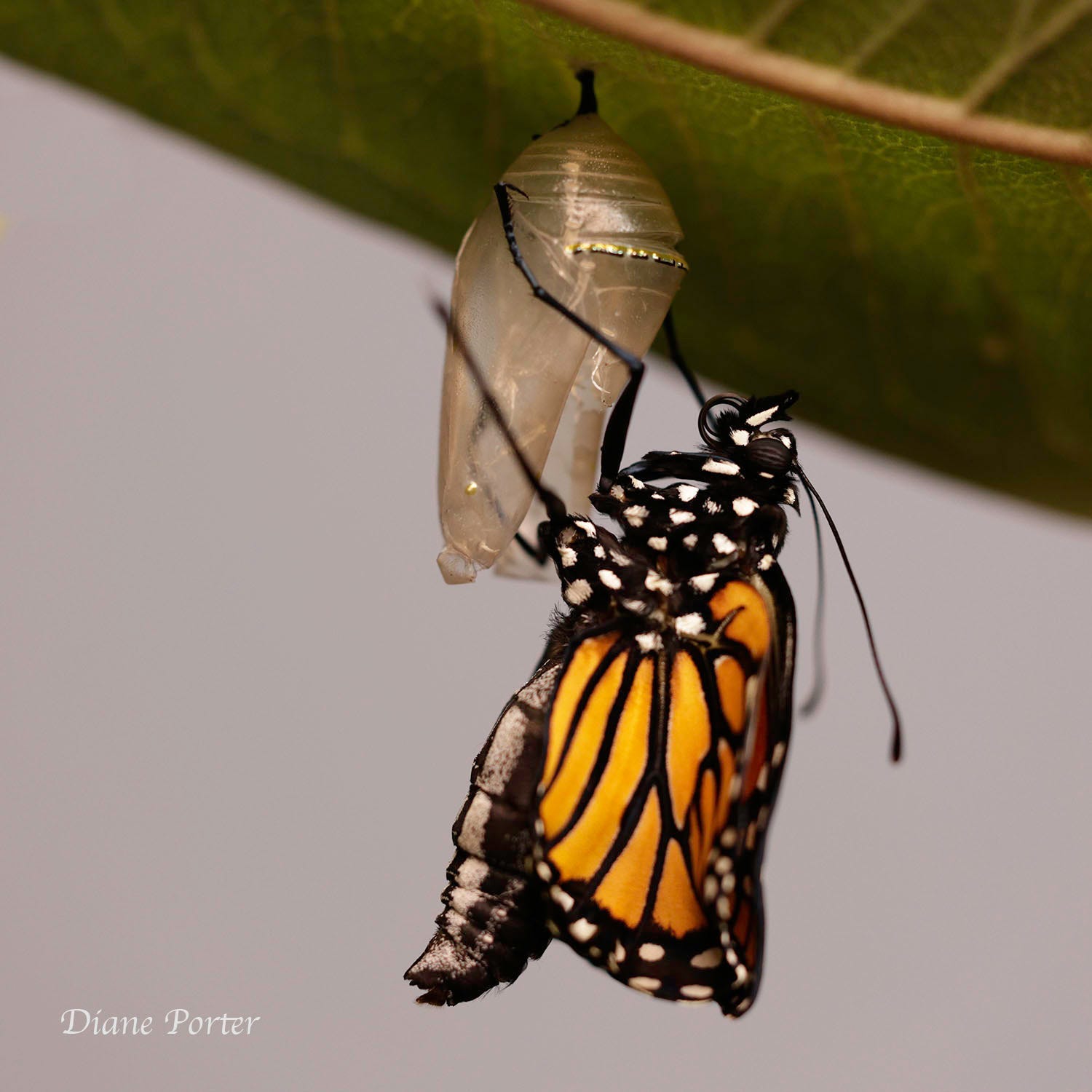
A few minutes later, the butterfly, a monarch, burst out and began to spread its wings:
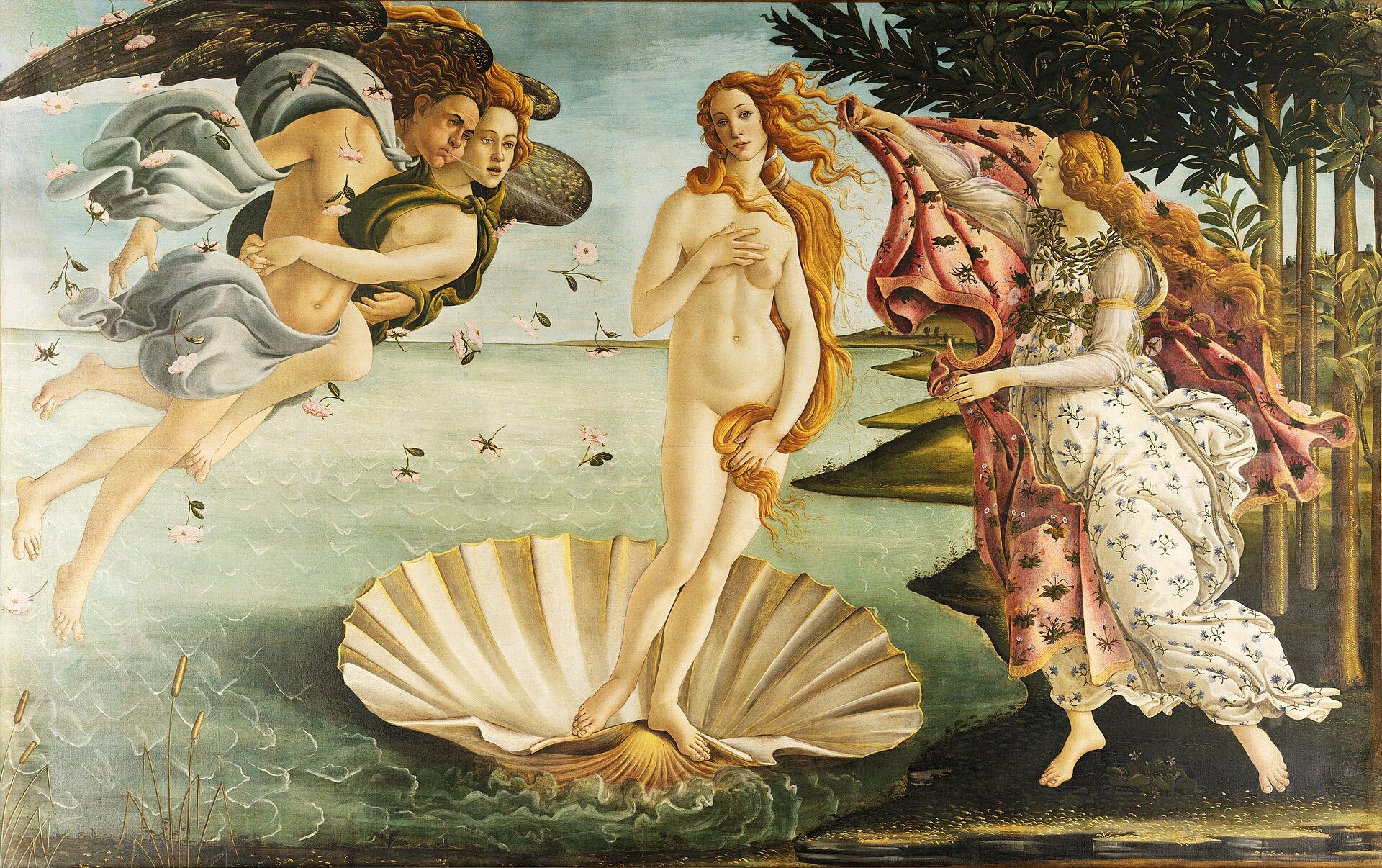
A gardener might look at this simply as one small victory for an endangered species. But for Porter, who calls her substack “My Gaia,” I imagine it must have tasted a little like being eyewitness to the birth of the goddess Venus, rising fully formed from the sea.
And this is what’s so quietly glorious about native gardening, so inspirational, so entertaining. I’m sitting on the porch as I write this, looking down at a small blended garden. To be honest, it’s mostly a leftover from our past non-native thinking. There’s a row of dwarf hydrangeas from god-knows-where, and a couple of pretty daylilies from Asia, now in flower. As far as wildlife goes, these plants are as lifeless as the parts of the yard still in grass.
But the native coreoposis and bee balms are alive with insects—ants, butterflies, a beetle, bumblebees, and a small dragonfly, which buries its head deep in a flower, presumably in search of insects to eat. A ruby-throated hummingbird darts in to feed, then off again to a nearby common evening primrose, a weedy volunteer. Toward dusk, I see a primrose moth visit that same flower, and tuck itself in as the petals fold around it, making it almost part of the flower, a different sort of metamorphosis, for shelter through the night.
What’s happening here is the recovery of an ecosystem that defined this place long before humans arrived on the scene. Maybe it won’t be a complete recovery, and maybe not forever. But for the moment, it will do just fine.
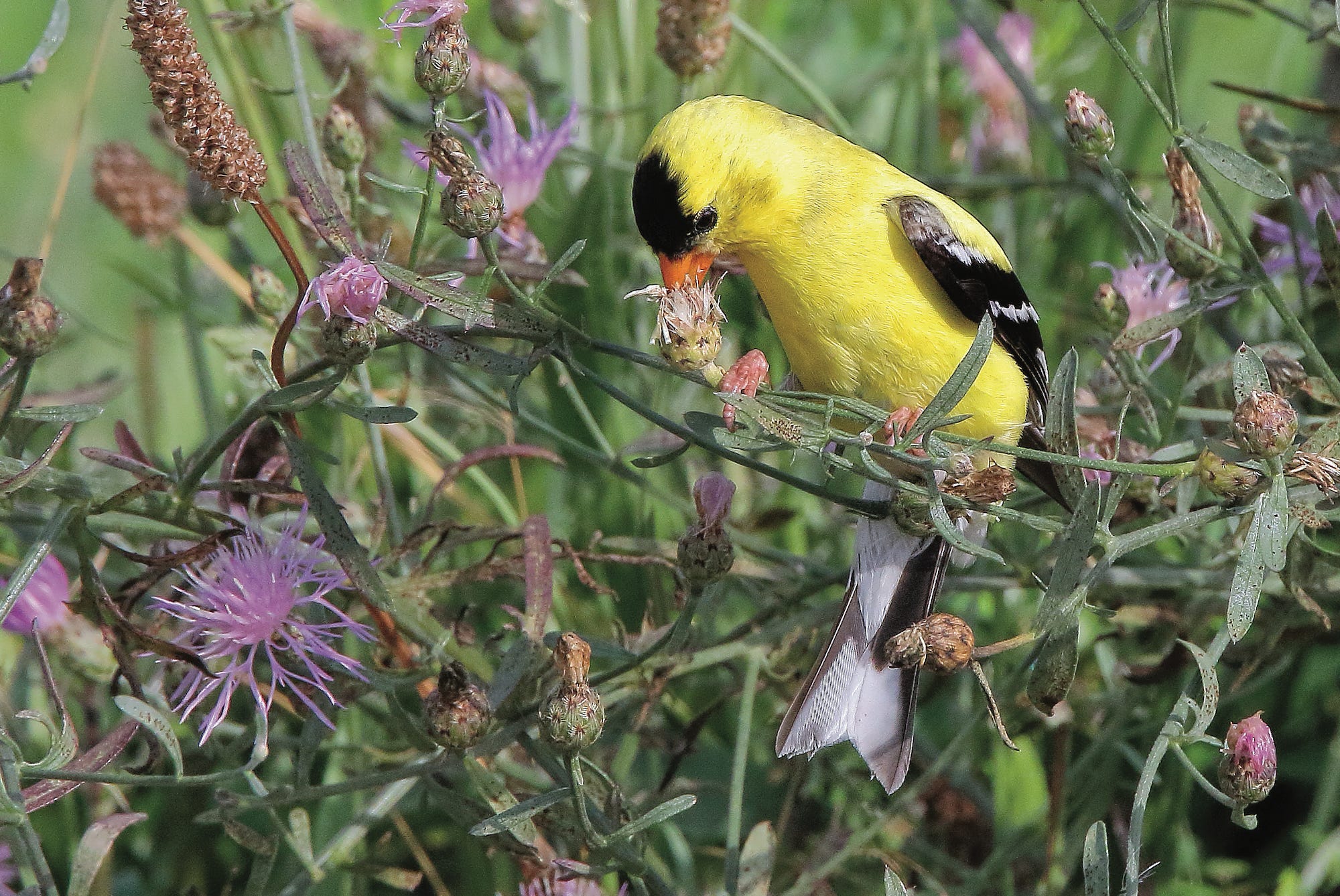
Correction: I mistakenly identified the flower in the opening photo as bee balm. It appears to be a variety of knapweed. Thanks to Kristine Johnson & Aaron Suiter for pointing out the error.
OTHER READING AND VIEWING
Mizejewski, David Attracting Birds, Butterflies, and Other Backyard Wildlife
Tallamy, Douglas, Bringing Nature Home: How You Can Sustain Wildlife with Native Plants (Timber Press, 2017)
Tallamy, D. Nature’s Best Hope: A New Approach to Conservation That Starts in Your Yard (Timber Press, 2020)
Vogt, Benjamin, Prairie Up: An Introduction to Natural Garden Design, for gardeners in the Midwest and beyond.
The Buzz on Native Plants (PBS, 2024)
On YouTube, check out Backyard Ecology, Lisa Likes Plants, Jacques in the Garden, and 90%Native.
On Reddit, both r/NativePlantGardening and r/NoLawns get upwards of 160,000 weekly visits.
T
Email comment from an educator who speaks and teaches native gardening to audiences around the state: "Just wanted to thank you for the uplifting article - it is a great start to my day today. So much is written about native gardening because of ecosystem collapse (and I’m guilty of this) but gardening for beauty and diversity and transformation is so important too. HOAs requiring part of yards be natives - who would have thunk it!
Thank you!"
Reading that was a great start to my weekend, thank you. I don't come across the term native gardens so much in the UK as I do wildlife gardens, but similarly, wildlife gardening has become much more mainstream in the past decade (yay!). Much emphasis has been on creating habitats for wildlife, necessarily embracing messy areas, and using pollinator-friendly plants, though not exclusively native species. There are, of course, still many people/organisations who can't/won't (yet) live with the messy side of a wildlife garden, but perhaps some orderly native gardening might appeal...