
Getting Close to Rhinos--Part 2
Is it better to be horned by an angry rhino? Or trampled? A guide finds out.

by Richard Conniff
This story continues from part one, which you can read by clicking here.
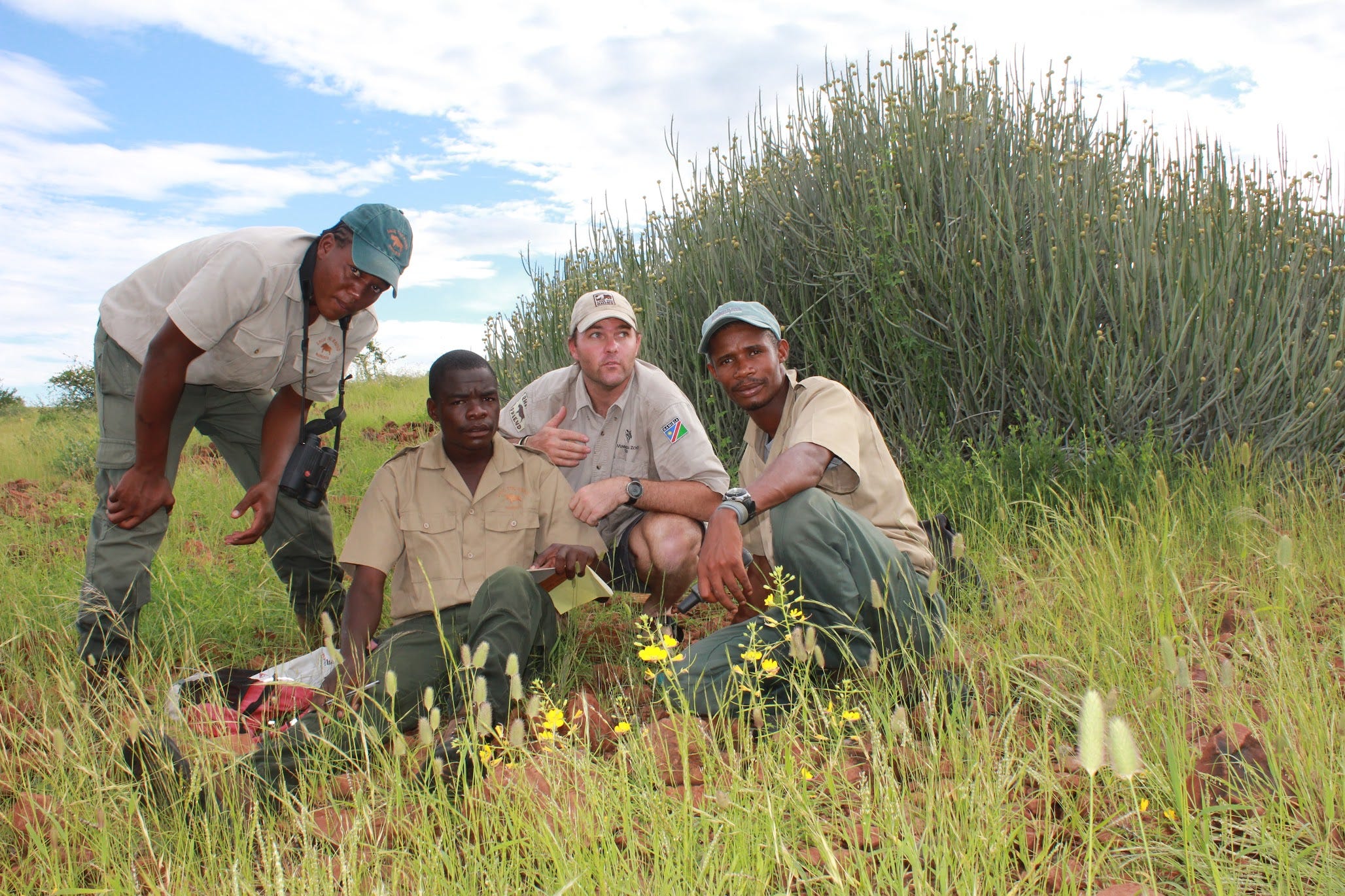
“The ideal sighting is when the rhino has no idea that you’re there,” Jeff Muntifering told me. He’s an American science adviser to Namibia’s Save the Rhino Trust (SRT), which manages the Desert Rhino Camp area, in partnership with the national government, local community conservancies, and Wilderness Destinations. The standard procedure is for SRT’s staff of rhino trackers to head out by truck early in the morning, with camp guests following behind in open game-drive vehicles, rolling up the broad desert valleys in a rumble of diesels and red dust. They visit a different one of four designated zones each day, to minimize the impact on wildlife.
The rhinos tend to be widely scattered, and they’re often on the move, browsing the shrubbery as they go. But the rhino trackers have an uncanny ability to spot a rhino with their naked eyes, even where Muntifering’s binoculars reveal nothing. Then everybody gets out to walk as quietly as possible, and for as long as it takes, on the trail of the rhino.
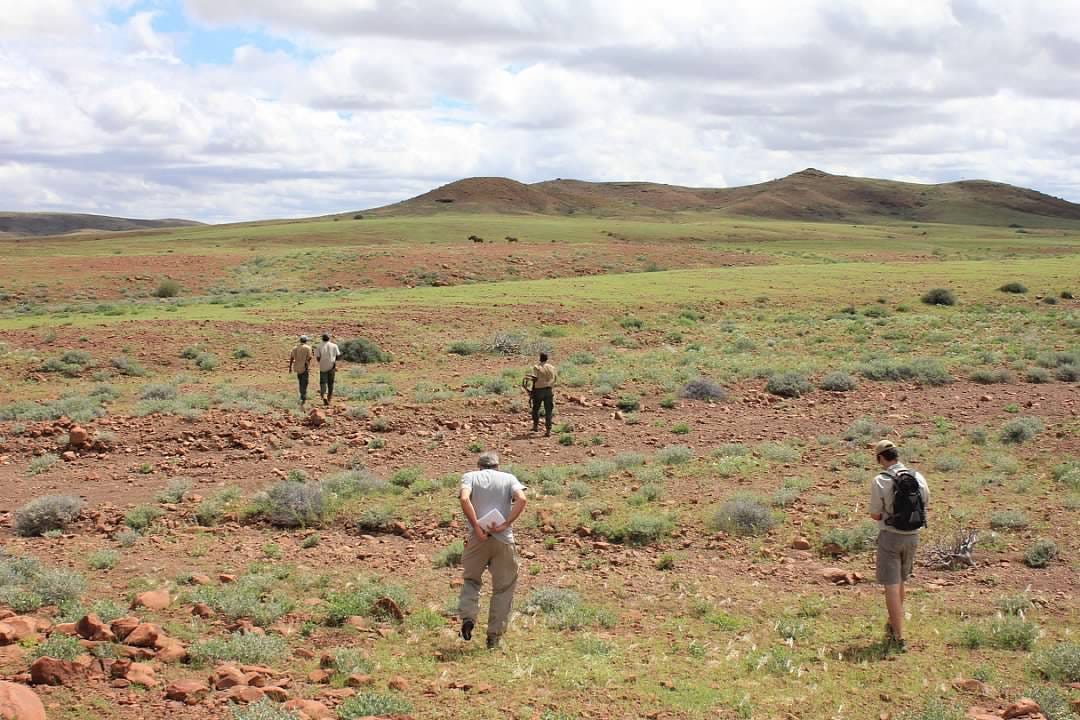
“We don’t go any closer than 100 to 150 meters,” said Muntifering, who was as careful and understated as Bakkes is flamboyant. At that distance, the trackers can identify the rhino and make photographs of the pattern of notches in its ears. Conveniently for guests, rhinos have a dismal sense of vision and, if the wind direction is right, a party of 10 or so people can stand there in the open undetected. The protocol is for the group to stay with the rhino no more than 15 minutes, then back off to 250 meters.
Rhinos can be quirky, curious, irascible creatures, and despite their ungainly appearance, they can sprint at 35 miles an hour. They normally race away from a sound that disturbs then—a foot slipping on a rock, say. Sometimes, though, they charge toward it. The day Bakkes had his accident (the one with the rhino, that is), a female rhino named Tina kept coming. Bakkes realized he had to stop her before she got to the guests.
“It’s worse to be horned by a rhino than to be trampled,” he explained. So when the rhino, weighing a ton or more, was two meters away and coming on at a gallop, he dropped down in front of her with his one good arm over his head. “They can’t get their horn into you when you’re on the ground,” he said.
She smashed into him with her nose and sent him skidding across the ground. He felt the hot blasts of her breathing, and the rhino snot against his neck. The earth rumbled under her stomping feet and he waited to be trampled. Instead she began to investigate his backpack, and when he opened one eye and peered out through the narrow opening between the brim of his hat and the ground, “a gigantic big toe was dancing about,” a few inches from his nose. Then the trackers came running up, throwing rocks and yelling “Voertsek! Voertsek!” (Afrikaans for “Bugger off!”), and the rhino turned and ran away. Bakkes dusted himself off and went back to work.
The desert has never been an easy place to make a living. There’s not usually much rain and it mostly falls in the first few months of the year. Vegetation is sparse and runty. This has been especially true over the past decade, when severe drought and the resulting food shortages for wildlife and humans alike have repeatedly pushed Namibia into a state of emergency. In 2024, the government took the drastic step of culling wildlife, including elephants, to protect land for food production and to provide meat for families no longer able to produce crops on their own.
It is a stark example of the rapidly accelerating toll of climate breakdown. When I visited in 2011, there was wildlife everywhere. Gemsbok, with a pair of three-foot-long unicorn horns on their foreheads, fled from us up the hillsides, looking like fanciful creatures out of a medieval bestiary. “They can go 5 or 6 days without water,” said Makumbi Swenyeho, then a Desert Rhino Camp wildlife guide. Other creatures adapt to the desert in ways that seem to flout their very nature. A giraffe spread out its front legs and canted its long neck down, not up, to browse on a stunted little thing known, unpromisingly, as the smelly shepherd’s tree. Such sightings are less common today, because of the prolonged drought.
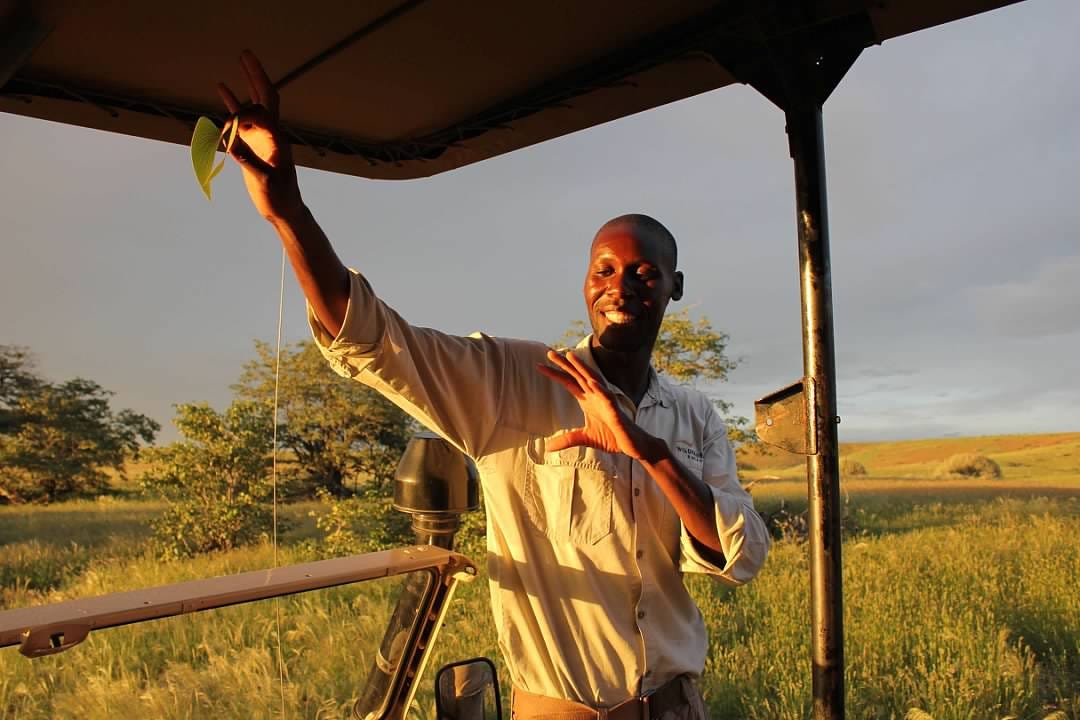
Swenyeho stopped at another bush and snapped open one of the pipe-like stems, which promptly bled a white latex liquid. The milk bush (Euphorbia damarana) is poisonous, he said, and contact with the skin can cause severe burning. Bushmen hunters use it on the tips of their arrows. But against all odds, rhinos have adapted to make it one of their staple foods out here in the desert. They also like the haystack shape of the milk bush so much that they sometimes climb aboard and fall asleep. Locals refer to the flattened remains as a “rhino mattress.”
The remarkable effort to save Namibia’s black rhinos started in this neighborhood in the early 1980s, at a time when poachers were slaughtering rhinos to sell their horns for use as dagger handles in the Middle East and as traditional medicine in China. Conservationists hired community game guards, some of them former poachers, to watch over the remaining rhinos. To instill a sense of ownership, Save the Rhino Trust conservationists arranged for the game guards to report to their traditional leaders, rather than to outsiders.
The rhino population slowly began to recover, from a low of about 60 individuals scattered across this region, up to about 180 at the time of my visit. Unlike the animals in a national park or a game ranch—both typically fenced--these rhinos are free to wander. The wilderness stretches 300 miles north to the Angola border, and it’s bounded on the west only by the massive dunes of the Skeleton Coast and the Atlantic Ocean. But the same animals tend to stay within a relatively limited territory, and the rhino minders often know them by name.
The real change for this wilderness came in the 1990s, after Namibia won its independence from South Africa and the new government turned ownership of the wildlife back to the people. The idea was to encourage communities living side-by-side with wildlife to manage and profit from it, usually through a combination of trophy hunting and tourism. Community conservancies now control about 17 percent of the national land area--more land than is protected in national parks. The government still sets sustainability limits on the harvest, and because rhino horn is such a precious commodity on the Asian black market, rhinos remain under strict national protection.
Until recently, poaching by locals had largely ended, because it felt like stealing from the neighbors. Communities get income and jobs through lease arrangements with tourism companies like Wilderness Destinations. That makes the sort of animals tourists come to see—particularly rhinos--suddenly seem far more valuable to local people. But the rhino poaching crisis has lately begun to spill over from both South Africa and Angola, with rhino horn now more valuable than gold on the illegal market. For Save the Rhino Trust, that just makes tourism more important.
“We see tourism as one of the key mechanisms to help save rhinos,” said Muntifering. “We just have to be careful about how we do it.” He uses GPS devices on the vehicles to track how often each of the four nearby zones gets visited. Then he compares that data with population surveys to see if tourism is affecting how many rhinos live there. The ambition is to fine-tune the link between rhino populations and tourism at Desert Rhino Camp, and then “start re-planting parts of that model out” in other conservancies around the country. (In the years since my visit, Save the Rhino Trust has established similar programs with seven other camps around northern Namibia.) Having monitors constantly in the field—along with tourists to pay their salaries-- is essential.
To read the conclusion of the story, click here.