
Getting Close to Rhinos--Conclusion
Another sighting and ... wait, is that rhino charging?

by Richard Conniff
This is the conclusion of a three-part series. You can start with episode one here, or go to episode two here.
Off in the distance, dark clouds piled up against the blue sky, sending down long charcoal-colored streaks of rain that bent and curved and finally seemed to kick up bright scatterings of dust on the ground. It was mating season, and all the animals were putting on a show. A species called the monotonous lark was in peak breeding form and the male repeated its listless three-note song well into the night: “I am dull but persistent. Have sex with me.” (Hear the thrill for yourself on eBird.) The Benguela long-billed lark was much splashier, shooting straight up in the air, then whistling
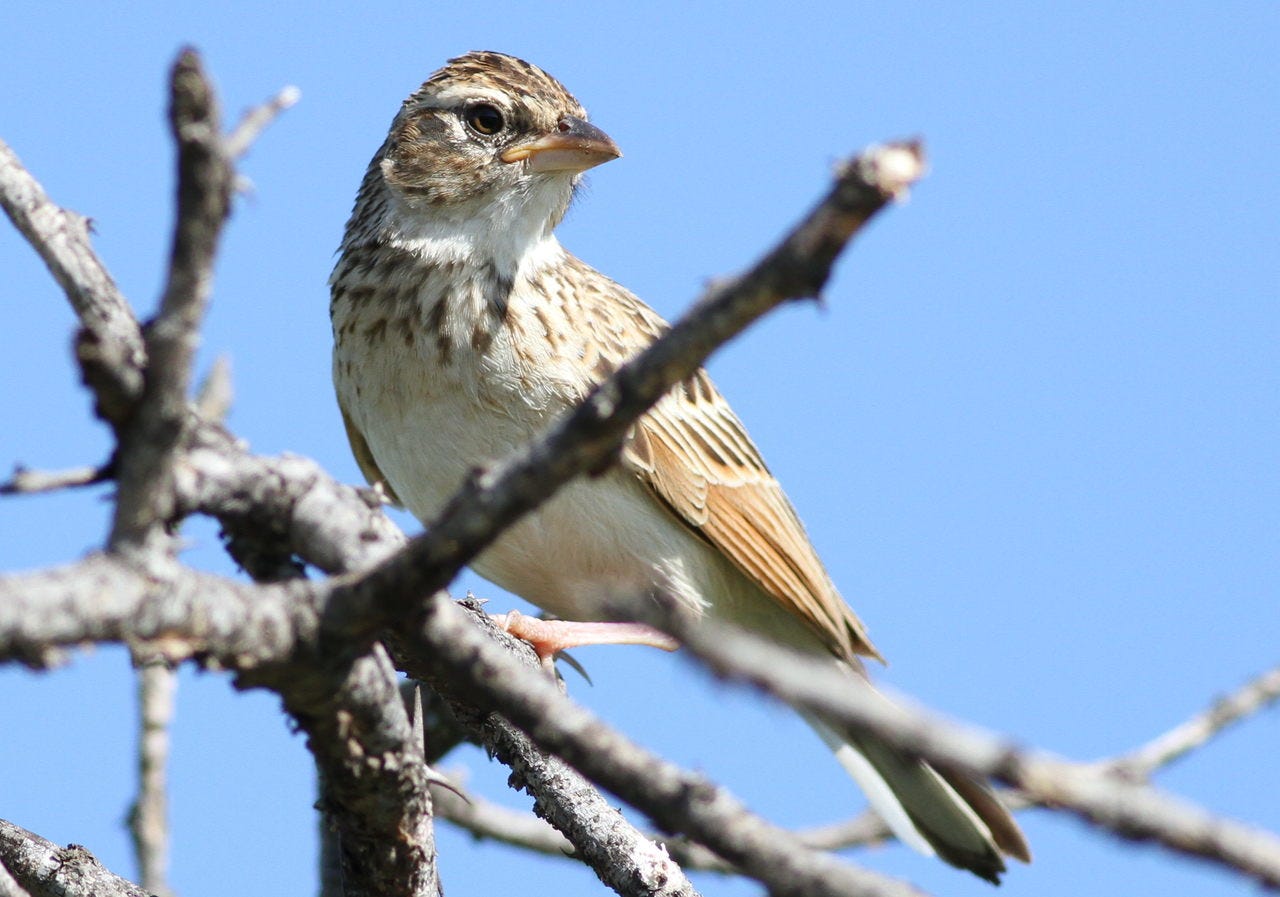
back down like an in-coming explosive round, “phewwwwwWWWW.” Even the monotonous lark females must have felt the ka-boom in their hearts.
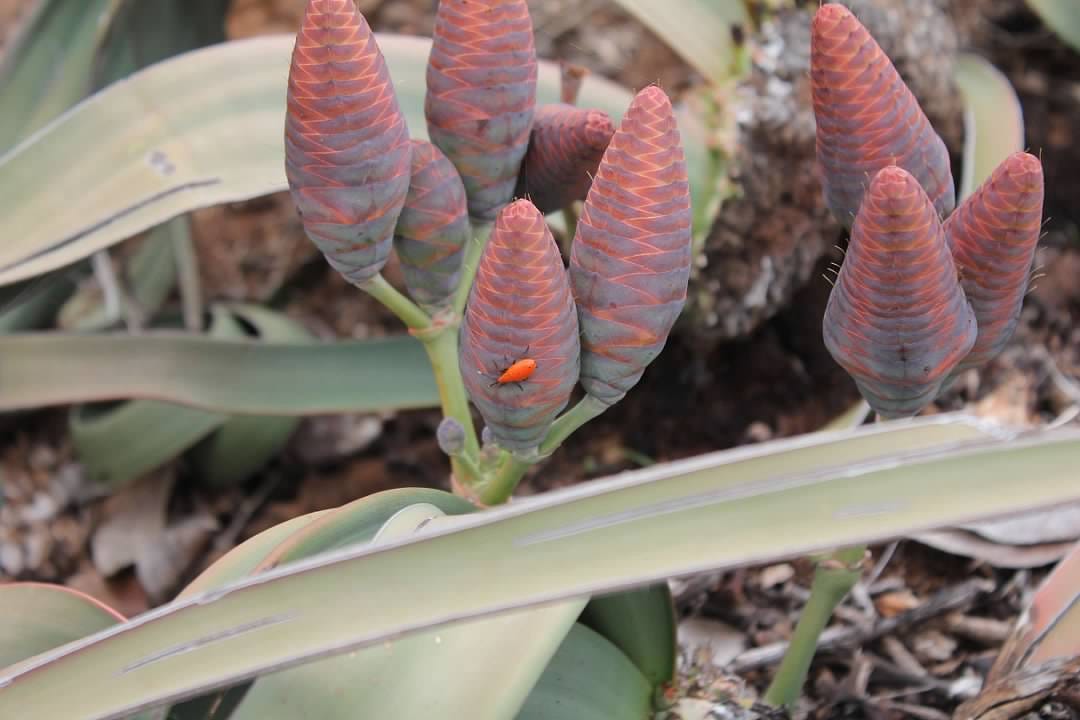
Success for Desert Rhino Camp depends on showing guests the lions, elephants, Welwitschia bugs, pale chanting goshawks, and any other wildlife that turns up along the way.
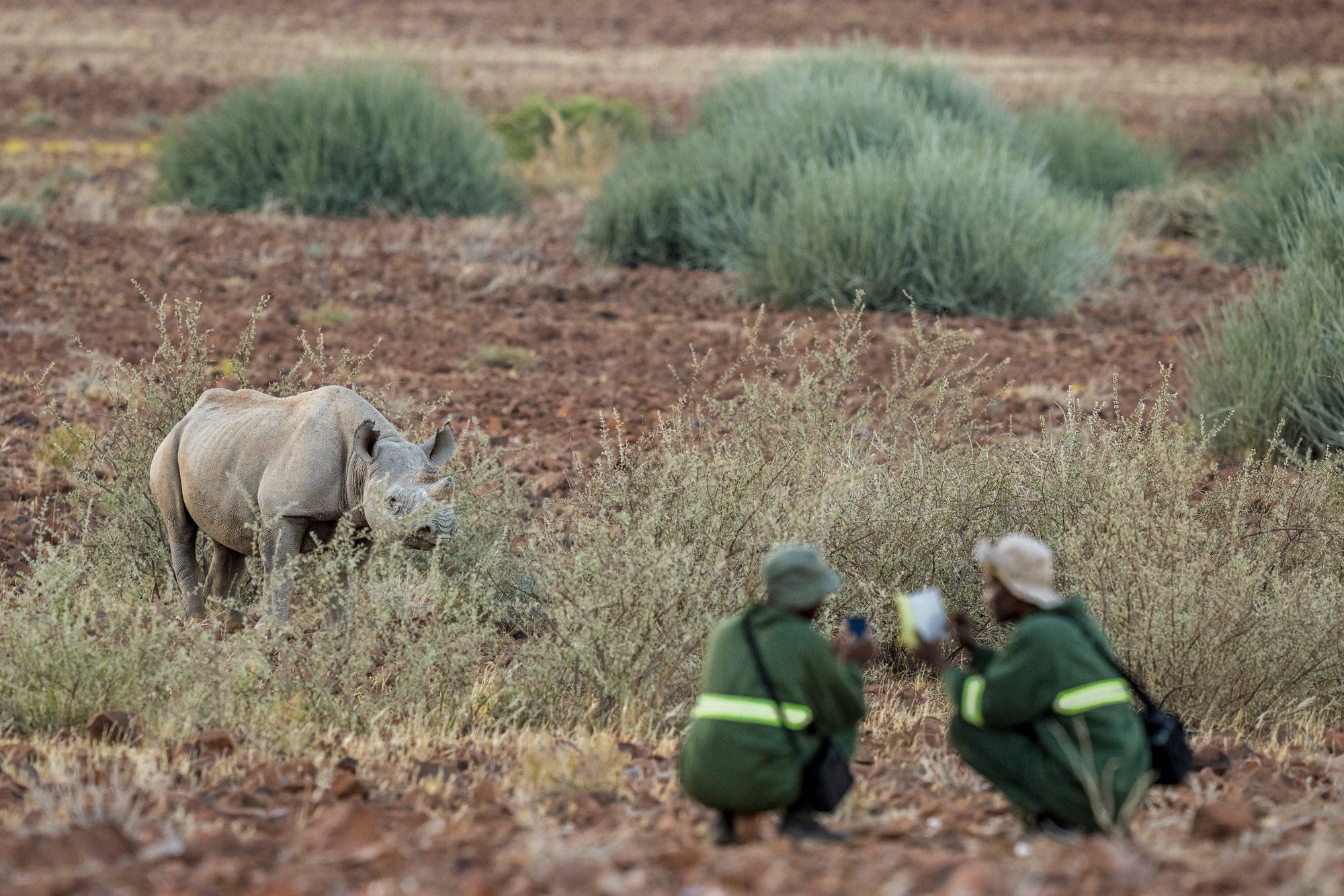
But mainly it’s about the rhinos. The first morning I went out was a textbook sighting: We nosed around in the vehicles for a couple of hours. Then we hiked quietly up into a high valley where a rhino mom with two huge horns stood calmly in front of us next to her calf, the pair of them looking as if Triceratops had somehow come back to life. One of the rhino trackers explained that this pair had a home range of 185 square miles. But they seemed happy enough standing right where they were.
Back at the lodge that night, sitting at the campfire, Bakkes did a sort of human version of Benguela long-billed lark behavior. He rolled his “r’s” and recited poetry. (“The Man from Snowy River” and Siegfried Sassoon on the “smug-faced crowds with kindling eye/Who cheer when soldier lads march by.”) He expounded on the special pleasures of this region, which can look, as a visitor once told him, like the most desolate wilderness on Earth: “You drive down the Hoarusib River to the Skeleton Coast, 100 kilometers along a dry river bed, a magnificent landscape surrounded by mountains, and you will not be stopped by any man-made objects, not a bridge, nor a highway, not a dam, a city, or a resort. You drive through open-range wilderness from the mountains to the sea. That’s what’s special about this place. That’s what I love about this place. It’s the old Africa.”
Next day was a little woollier. At eight a.m., the trackers spotted a rhino going behind a bend and we got out to follow on foot. The rains had made the desert go crazy, with knee-high grass growing everywhere. It was hilly country, and the ground was littered with ankle-turning red rocks. The trackers hoofed it, anyway, and Muntifering and I managed to tag along just behind. It was like running through knee-deep confetti across a floor covered in billiard balls. Bakkes was guiding a family with young kids, and they fell back, as the dad struggled under a telephoto lens like a bazooka.
We crossed fresh elephant footprints, each of them a crater punched into the wet red earth. After about a mile, we were just drawing up to the rhino when the trackers suddenly froze. Then we heard the sharp hollow sound of galloping across loose rock. Muntifering veered uphill, away from the sound. I followed, both of us scanning the brush for some hint of trajectory.
Then the rhino burst into sight, thundering along at full gallop. It felt like being caught in the crosswalk when an SUV driver with an unusually small brain and an oversized anger management problem suddenly mashes the accelerator. But Tensie—as the trackers tentatively identified him--was just trying to avoid us. A few hundred meters later, he cut up the hill across from us and jogged over the ridge and away.
After a few minutes, Bakkes turned up with his group, declaring that they had enjoyed “a grandstand view.” The tourist with the bazooka lens had made a dismal photograph—an extreme close-up of the right ear of a fleeing rhino. But it turned out to be a small triumph. Muntifering studied the identifying notches in the ear and confirmed that it was, in fact, Tensie. (Coincidentally, he was the son of Tina, the same rhino who had wiped her nose on Bakkes’s neck.)
On the drive back to camp, we found the herd of elephants. They were red as the desert soil from rolling in the mud and dusting themselves. They ignored us as we slipped slowly past, at a distance of 50 or 60 meters. The rain started coming down again in the distance. But around us, the sun still shone, and the seed heads on the high grass nodded and danced in the breeze. It was hard to resist a bursting sense of exuberance at being out on such a day and in such glorious country.
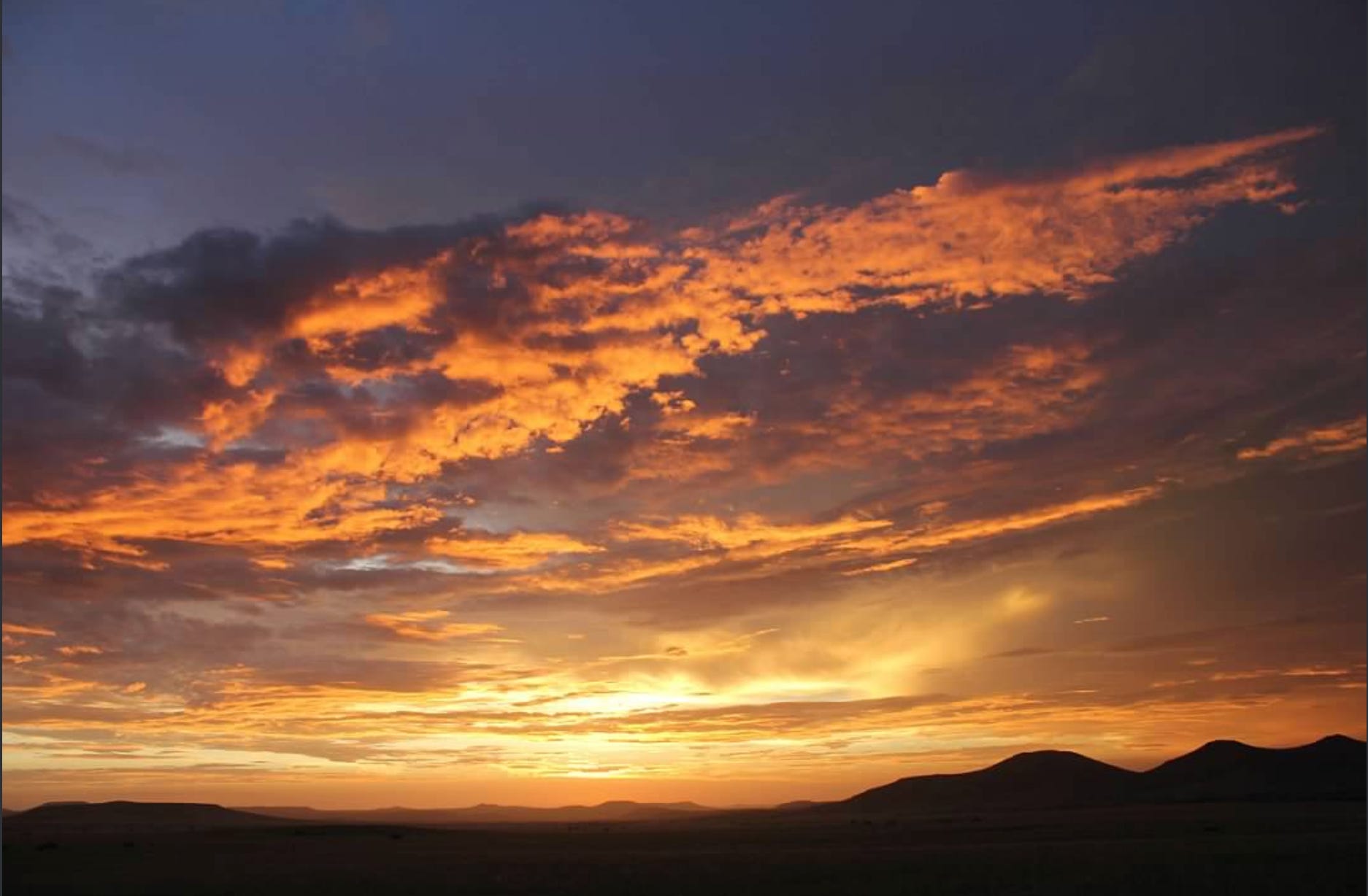
Postscript: Early this year, the skies darkened over the parched landscape of northern Namibia, and a massive rainfall rolled in. It was the sort of blessed relief that leads people to stand still, hands spread, faces craned up, getting soaked to the bone and rejoicing in it. “I’d only known Rhino Camp as rock and stone and sand,” says Hamish Hofmeyr, who has been manager there for the past four years. And overnight “it was transformed into huge waving fields” of grass, which means grazing. One year is not soon enough to restore lost wildlife populations. But for now, most game drives still end in a rhino sighting, and the hope is for a few good years of continued rain ahead.
OTHER READING AND VIEWING:
Conniff, Richard (2024) The Pleasures & Perils of An African Safari
Conniff, Richard (2024) On the Track of the Cat (traveling with Kung San trackers in northern Namibia)
Conniff, Richard (2024) In Namibia, a Lauded Community Conservation Model Is at Risk
Muntifering, J. et al (2020) Lessons from a conservation and tourism cooperative: the Namibian black rhinoceros case
Muntifering, J. et al (2023) From seeing to saving: How rhinoceros-based tourism in north-west Namibia strengthens local stewardship to help combat illegal hunting
Muntifering, J. et al (2025) Pathways to more inclusive and effective black rhino conservation: Insights from a decade of design and delivery in NW Namibia.
Save the Rhino Trust (2022), a 25-minute film on the work to save rhinos in Namibia.